
Episode 4:
M0bility
in Kauaʻi county

Worker mobility in kaua’i COunty:
How many workers are there, and who has a chance to advance?
Kaua’i County has 37,000 workers who are skilled through alternative routes (STARs). 31% earn above a living wage, and 3,012 are within $10,000 of a living wage.
In Kauaʻi County, an estimated 3,012 workers are within $10,000 of a living wage—representing individuals who are already participating in the labor market, but whose earnings fall just short of long-term economic stability. Many workers are further from this threshold, but a meaningful share of residents are already within reach. The challenge to get all workers to a living wage exists at different layers, but one of those layers is immediately actionable.
This creates a clear starting point for action. By focusing on workers who are already close to a living wage, Kauaʻi County can begin to build and test mobility pathways—connecting accessible jobs to roles that provide long-term economic stability.
The research from UHERO provides a clear view into what happens when workers successfully transition into higher-wage roles. Participants in Good Jobs Hawaiʻi experienced approximately $7,200 in annualized wage gains within two quarters of completing training.
Applying this observed outcome to Kauaʻi County suggests a significant opportunity. If workers within reach of a living wage were able to make similar transitions, the result would be a meaningful shift in individual earning trajectories—moving from roughly $56,611 per year to more than $63,811.
Programs like Good Jobs Hawaiʻi demonstrate that these outcomes can be achieved at relatively low cost—approximately $2,000 per participant. At full scale, supporting these transitions across the full population would require a substantial investment, but the more practical question is what becomes possible if we act consistently over time.

Why it matters:
potential worker and economic impact in kauaʻi County
On Kauaʻi, supporting approximately 300 workers per year—roughly 10% of those within reach of a living wage—creates a compounding effect over time.
Each year, a new group of workers would gain access to higher-wage opportunities. As those gains accumulate, the number of residents earning sustainable wages steadily increases. Over time, this begins to shift not just individual outcomes, but the overall distribution of earnings within the county.
After ten years, this approach would support approximately 3,000 workers. Based on observed outcomes from Good Jobs Hawaiʻi, this would generate more than $119 million in additional earnings over that period. The total investment required—approximately $6 million over ten years—is modest in comparison.
Strategically investing in workforce mobility pathways in Kauaʻi County could yield a return of nearly $20 in additional earnings for every $1 invested.
When we extend this model beyond individual earnings, the broader economic impact becomes clearer. Over ten years, the projected wage gains—approximately $119 million—translate into roughly $167 million in total economic activity in Kauaʻi County when accounting for how income circulates through the local economy.
This reflects a simple but often overlooked dynamic: when residents earn more, they spend more locally—supporting businesses, services, and jobs across the community.
At a total investment of approximately $6 million, this represents a return of nearly $28 in economic activity for every $1 invested. To understand the significance of this impact, it helps to place it in the context of Kauaʻi County’s overall economy. Kauaʻi County’s total economic output is approximately $5.5 billion per year. At full scale, the annual impact of this model represents a measurable share of that total—on the order of a few tenths of a percent of the island’s economy each year—large enough to be felt across a smaller, more interconnected economy.
This growth is not driven by the creation of new industries or the attraction of external investment. It is generated by improving how residents move into and through existing opportunities—unlocking economic potential that is already present within the local workforce.
This is not just about economic growth, it’s about shaping the quality of the economy over time—supporting more residents in accessing jobs that provide stable, living wages within the industries that already exist.
So where should Kauaʻi focus first?
Which parts of the economy offer access, wages, or growth—and where do those conditions need to be strengthened to create real mobility pathways?

Continue reading for all the details, or jump to the Kauaʻi County summary.
Kauaʻi’s workforce system is defined by high access and emerging demand—but limited scale and inconsistent wage sustainability.
As a result, many workers can enter the labor market—but fewer have access to clear, reliable pathways into living-wage careers.
While statewide data helps us understand broad patterns, the conditions that shape real career pathways—employer demand, training capacity, wages, and access—are experienced locally. In Kauaʻi County, we see emerging signals of aligned opportunity in sectors like healthcare and construction—industries where accessible roles, living wages, and employer demand begin to intersect. By focusing on the county level, we can get a clear snapshot of current conditions and model what sustained progress could look like in a way that is both concrete and grounded in real labor market conditions. To move from analysis to action, we grouped industries based on how access, wages, and growth come together in practice.
Summary of kaua’i Industries
Industries and specific factors are color-coded based on their potential to support economic mobility.
Partial
With only one or two factors inconsistently present, these are not full mobility pathways. But they are still important.
Limited
These sectors do not currently support mobility at scale because factors are not aligned.
Building
These are almost mobility pathways with 2 of the 3 factors present, but something is blocking the third factor.
Anchor
Already functioning mobility pathways where access, living wages, and momentum are aligned.
The table below shows how we categorized each industry as anchor, building, partial, or limited based on momentum, access, and median STAR wage.
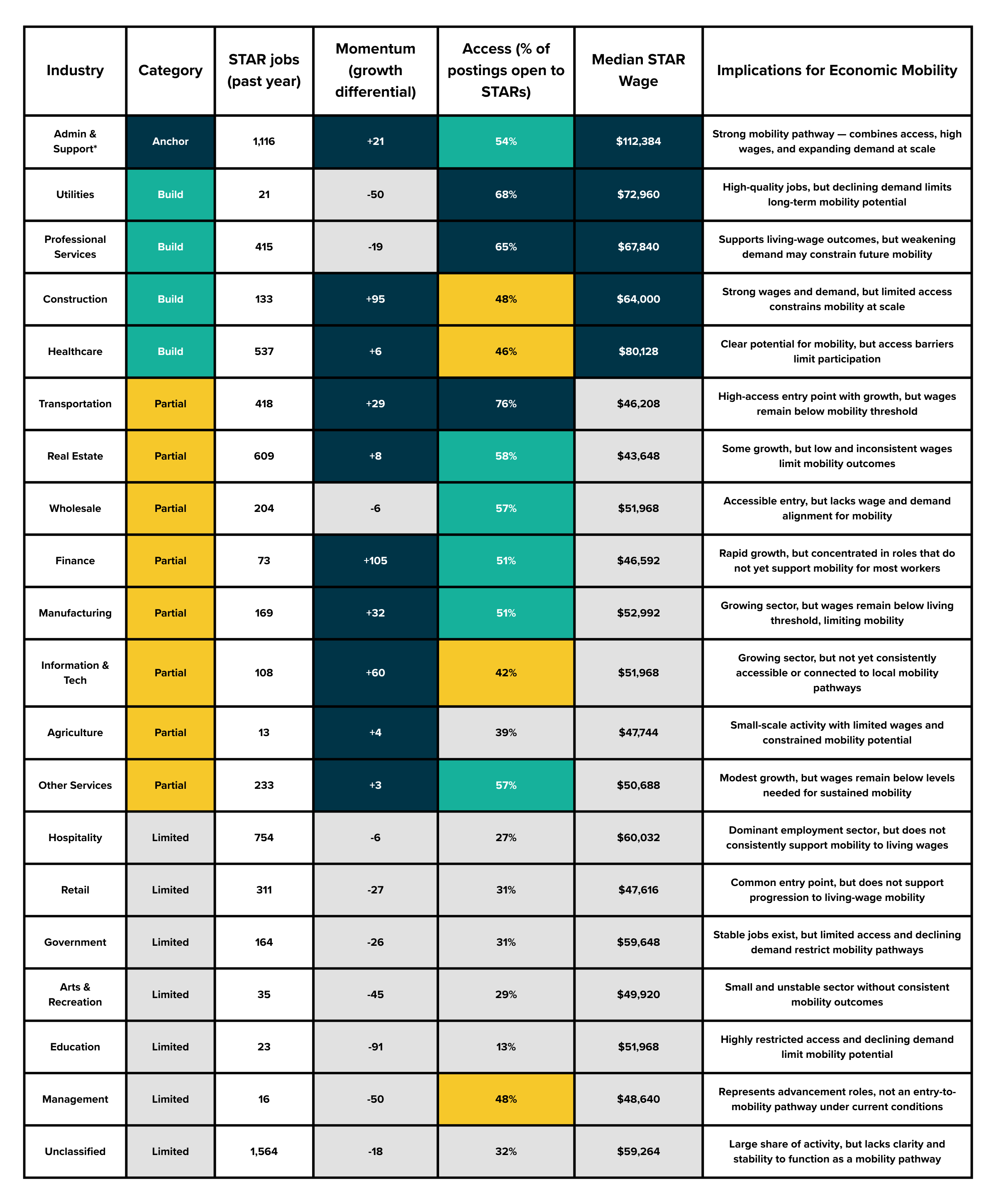
*Admin & Support is largely made of healthcare staffing agencies.
Administration and Support:
Healthcare is actually the Anchor
When we filter to industries where STARs roles meet the living wage threshold, one category stands out clearly on Kauaʻi—but requires careful interpretation.
54% of roles are STARs-accessible
Median STAR wage: ~$112,000 (well above living wage)
Strong growth across both segments: +69% overall, +90% STARs
+21 percentage point growth differential
~2,000 postings (meaningful scale for Kauaʻi)
At first glance, this appears to be a well-aligned sector—combining access, strong wages, and sustained growth. However, as in other counties, the underlying job postings reveal that this signal is driven primarily by healthcare roles—particularly nursing and allied health positions—posted through staffing and intermediary firms.
On Kauaʻi, this pattern is even more pronounced. With fewer sectors reaching similar levels of alignment, healthcare demand—surfaced through staffing channels—emerges as the dominant source of accessible, living-wage opportunity in the county. The concentration of healthcare roles within staffing and intermediary firms may also reflect how employers are responding to workforce shortages. Rather than hiring directly into permanent roles, demand may be shifting toward contract, temporary, or travel-based staffing models. This means the strong growth captured in this category may not represent a new sector—but rather a change in how existing demand is being met.
Kauaʻi County shows clear evidence that healthcare is the central workforce anchor—representing one of the few sectors that combines scale, access, and strong wages, and therefore carrying disproportionate importance in shaping local workforce opportunity. What this looks like in practice:
Common roles (by posting volume)
Registered Nurses — 285
Radiologic Technologists and Technicians — 145
Diagnostic Medical Sonographers — 78
Respiratory Therapists — 67
MRI Technologists — 65
Top hiring employers
AMN Healthcare — 103
Titan Medical — 90
Allied Universal — 67
Soliant Health — 56
HiEmployment — 54
What the Data Suggests
1. Healthcare demand is the primary driver of high-quality jobs. Most high-wage, STARs-accessible roles are concentrated in clinical and technical healthcare occupations.
2. Staffing firms act as intermediaries, not endpoints. Many postings come through staffing agencies, reflecting how employers are filling demand rather than where careers ultimately reside.
3. Opportunity is concentrated in one dominant system. With fewer sectors reaching similar levels of alignment, healthcare plays an outsized role in the county’s workforce landscape.
Kaua’i has a very small set of aligned or nearly-aligned sectors: construction; healthcare & social assistance; Professional, Scientific & Technical Services; utilities
These sectors show alignment between access, economic sustainability, and momentum, with the possibility of becoming strong workforce pathways to mobility.
Construction
(Nearly aligned, high momentum)
On Kauaʻi, Construction represents a near-aligned sector—where demand, wages, and access are beginning to converge, but expanding entry pathways will be critical to translating growth into broad-based opportunity.
48% STARs access (just below threshold)
STAR wage: ~$64,000 (above living wage)
Extremely strong growth: +115% overall, +210% STARs
+95 percentage point growth differential
Demand is increasing rapidly, and growth is concentrated in STARs-accessible roles—indicating that opportunity is expanding within positions that do not require a four-year degree. Many of these roles are part of the skilled trades, offering pathways into stable, living-wage careers.
At the same time, access has not yet expanded to match the pace of demand. While wages and growth are strong, entry into these roles is not yet broad enough to support widespread participation.
Common roles (by posting volume)
Electricians — 12
Maintenance and Repair Workers — 11
Administrative Assistants — 8
Solar Photovoltaic Installers — 7
Production, Planning, and Expediting Clerks — 6
Top hiring employers
Sunrun — 15
Unlimited Construction Services — 10
Pacific Mirror & Glass — 9
Sunrun Installation Services — 8
Boyer Enterprises — 8
What the Data Suggests
1. Growth is being driven by skilled trades and infrastructure roles. Electricians, HVAC, solar installers, and water systems work point to sustained demand in construction and utilities-related activity.
2. Clean energy and infrastructure are emerging drivers. The presence of firms like Sunrun suggests overlap between construction and energy systems.
3. The constraint is access, not demand. Jobs are growing quickly and wages are above the living wage threshold—but entry into these roles has not yet scaled to match the opportunity.
Healthcare & Social Assistance
(High quality, but constrained)
On Kauaʻi, Health Care & Social Assistance represents a high-quality but access-constrained pathway—where strong wages and stable demand exist, but expanding entry and training pathways will be key to increasing participation at scale.
46% STARs access
STAR wage: ~$80,000
Slight contraction: -8% overall, -2% STARs
+6 differential
This is a high-quality sector where wages are strong and demand is relatively stable. While overall job postings show a slight decline, this does not necessarily indicate a reduction in underlying demand. Instead, some of that demand may be appearing in adjacent categories—particularly through staffing and intermediary firms—suggesting a shift in how healthcare roles are being filled rather than a reduction in need.
At the same time, STARs-accessible roles are holding more steady, indicating continued demand for degree-optional positions. The sector includes a range of roles—from administrative and support positions to clinical and technical occupations—creating multiple entry points and opportunities for advancement. However, access remains moderate rather than broad. Entry into many higher-wage roles still depends on credentials, certifications, or prior experience, limiting how widely these opportunities are distributed across the workforce.
Common roles (by posting volume)
Registered Nurses — 103
Health Technologists and Technicians — 59
Licensed Practical & Vocational Nurses — 33
Clinical Laboratory Technologists and Technicians — 29
Medical and Health Services Managers — 24
Top hiring employers
Sonic Healthcare USA — 75
The Queen’s Health Systems — 54
Hawaiʻi Pacific Health — 45
Kauaʻi Care Center — 34
Prime Time Healthcare — 27
What the Data Suggests
1. Wages are consistently strong across roles. Many positions—particularly clinical and technical roles—offer earnings well above the living wage threshold.
2. Demand is stable—but may be shifting in how it is met. Slight contraction in direct postings suggests a mature system with ongoing need, while some demand may be moving through staffing and intermediary channels rather than traditional hiring.
3. Access is the primary constraint. Entry into higher-wage roles often requires specific credentials, making training and career navigation critical to expanding opportunity.
Professional, Scientific & Technical Services (fragmented signal, not a defined mobility pathway)
On Kauaʻi, Professional, Scientific & Technical Services represents a fragmented signal rather than a defined pathway—where strong metrics do not translate into a clear, scalable route for workforce mobility.
65% STARs access (high)
STAR wage: ~$67,000
Growth slowing: +43% overall vs +24% STARs
Negative differential
At first glance, this sector appears strong—combining high access with wages above the living wage threshold. However, a closer look at the underlying job postings reveals a highly fragmented mix of roles and employers spanning multiple industries. The occupations captured in this category—including healthcare, retail, logistics, administrative, and technical roles—do not reflect a single, coherent workforce pathway.
As a result, while many roles are accessible and reasonably well-compensated, the sector does not show consistent expansion within STARs-accessible positions. Instead, it reflects a collection of unrelated opportunities grouped under a broad industry classification.
Common roles (by posting volume)
Registered Nurses — 41
Electrical and Electronics Installers and Repairers — 33
Merchandise Displayers and Window Trimmers — 23
Health Technologists and Technicians — 20
Network and Computer Systems Administrators — 17
Top hiring employers
Amentum — 88
Prolink S.A.S — 44
Kupono Government Services — 43
Terraboost Media — 22
H&R Block — 20
What the Data Suggests
1. The category blends unrelated types of work. Roles span healthcare, retail, logistics, and technical fields, indicating that the sector classification is capturing multiple distinct labor markets.
2. High access does not equal a clear pathway. While many roles are degree-optional, they do not connect into a single progression or career ladder.
3. Growth is not concentrated in STARs roles. Slower growth among accessible roles suggests limited expansion of opportunity within this category.
Utilities
(high quality, but very small)
On Kauaʻi, Utilities represents a high-quality but low-scale pathway—where strong individual opportunities exist, but the sector is too small to function as a primary driver of workforce mobility.
68% STARs access
Strong wages (~$73K)
High volatility: +200% vs +150%
Only ~31 postings
This sector offers high-quality roles that are both accessible and well-compensated. Many positions—particularly in infrastructure, energy, and water systems—provide stable, living-wage employment without requiring a four-year degree.
However, the overall number of opportunities is extremely limited. Even with strong growth rates, the total volume of postings remains too small to significantly impact workforce outcomes at the county level. The volatility in growth further reflects how small changes in hiring can appear large in percentage terms.
Common roles (by posting volume)
Securities, Commodities & Financial Services Sales Agents — 4
Plant and System Operators — 4
Electrical Power-Line Installers and Repairers — 2
Water and Wastewater Treatment Operators — 2
Millwrights — 2
Top hiring employers
Kauaʻi Island Utility Cooperative — 6
American Water — 5
Hawaiian Electric Industries — 4
Hawaiian Electric Company — 3
NiSource — 1
What the Data Suggests
1. Jobs are high quality and infrastructure-oriented. Roles are tied to essential systems—energy, water, and utilities—offering stable, technical career opportunities.
2. Scale is the defining constraint. With only a few dozen postings, even strong wages and access cannot translate into system-wide impact.
3. Growth rates should be interpreted cautiously. Large percentage changes reflect small underlying numbers, not sustained expansion.
The defining pattern:
Access without sustainability
The most consistent pattern on Kauaʻi emerges when looking at sectors that combine high access and strong demand—but fall below the living wage threshold.
Transportation & Warehousing
On Kauaʻi, the dominant workforce pattern is access without sustainability—where workers can readily enter the labor market, but those opportunities do not consistently translate into living-wage careers.
76% STARs access (very high)
Median wage: ~$46,000 (below living wage)
Strong growth: +59% overall, +88% STARs
+29 differential
This is a high-access, high-demand sector where opportunity is expanding rapidly—particularly in roles that do not require a four-year degree.
However, wages remain below the level required for long-term economic stability. Many of the roles driving demand—such as customer service, logistics support, and transportation operations—provide entry into the workforce, but do not consistently offer pathways to higher earnings. As a result, the sector functions as a reliable point of entry, but not as a complete pathway to economic mobility. In practice, this means many workers can find jobs—but not jobs that consistently allow them to stay and get ahead without additional advancement or transition.
Common roles (by posting volume)
Airfield Operations Specialists — 132
Customer Service Representatives — 55
Postal Service Clerks — 51
Aircraft Mechanics and Service Technicians — 29
Driver/Sales Workers — 22
Top hiring employers
Unifi Aviation — 134
United States Postal Service — 50
Hawaiian Holdings — 26
Alaska Airlines — 19
Holo Holo Charters — 12
What the Data Suggests
1. Access is not the primary barrier. A large share of roles are available to workers without a four-year degree, making entry into the workforce relatively attainable.
2. Wages limit long-term stability. Many roles cluster below the living wage threshold, constraining upward mobility even as employment expands.
3. Growth reinforces the pattern rather than resolving it. Strong expansion in STARs-accessible roles suggests that this model—high access, lower wages—is becoming more entrenched over time.

Emerging but incomplete growth sectors:
information & Technology; finance; manufacturing
These sectors are growing, but do not have all factors present to become real mobility pathways.
Information & Technology
(strong signal, not yet viable)
On Kauaʻi, Information & Technology represents an emerging but incomplete pathway—where access is expanding and demand is shifting, but wages and role alignment have not yet reached the level needed to form a stable, scalable career pathway.
42% STARs access
STAR wage: ~$51,000 (below living wage)
Growth diverging sharply: -24% overall, +36% STARs)
+60 differential
This sector shows an emerging shift toward STARs-accessible roles, with growth occurring primarily in positions that do not require a four-year degree. However, wages for these roles remain below the living wage threshold, limiting their ability to support long-term economic stability. At the same time, the underlying job postings reflect a wide mix of occupations—including sales, customer-facing, operational, and maintenance roles—rather than a concentrated set of technical positions.
This suggests that what is being captured here is not a fully developed technology sector, but a broader set of roles connected to telecommunications, services, and support functions.
Common roles (by posting volume)
Sales Representatives (Technical & Non-Technical) — 24
Maintenance and Repair Workers — 22
Sales Representatives (Technical) — 13
Advertising Sales Agents — 7
First-Line Supervisors (Hospitality/Operations) — 6
Top hiring employers
Travel & Leisure Group Ltd — 80
Verizon Communications — 12
Altafiber — 7
American Greetings — 2
Australian Broadcasting Corporation — 1
What the Data Suggests
1. Growth is concentrated in non-technical roles. Many postings are in sales, operations, and support functions rather than core software or engineering positions.
2. Wages have not yet reached sustainability. Earnings remain below the living wage threshold, limiting long-term viability as a primary pathway.
3. The sector is still forming locally. The mix of roles and employers suggests an early-stage or indirect presence of the tech economy, rather than a mature, locally anchored sector.
Finance
(emerging but limited pathway)
On Kauaʻi, Finance represents an emerging but limited pathway—where access and growth are increasing, but scale and wage levels are not yet sufficient to support broad-based economic mobility.Very low access (~8%)
51% STARs access
Low wages (~$46K)
Strong growth: +45% overall, +150% STARs
+105 differential
This sector shows strong growth momentum, particularly within STARs-accessible roles. Demand is expanding in positions that do not require a four-year degree, indicating increased accessibility.
However, the overall number of postings remains limited, and wages for many roles fall below the living wage threshold. The roles driving growth—such as sales, customer service, and entry-level financial services positions—provide access to the sector, but do not consistently offer pathways to higher earnings without additional advancement or specialization.
Common roles (by posting volume)
Securities & Financial Services Sales Agents — 17
Market Research Analysts and Marketing Specialists — 16
Accountants and Auditors — 5
Sales Representatives (Services) — 5
Insurance Sales Agents — 3
Top hiring employers
Bank of Hawaiʻi — 18
PayPal — 17
Gather Federal Credit Union — 11
HMC — 3
Garden Island Federal Credit Union — 3
What the Data Suggests
1. Growth is concentrated in entry and sales-oriented roles. Many positions focus on customer-facing or transactional work rather than higher-wage financial management roles.
2. Scale limits system impact. Even with rapid growth, the total number of jobs remains relatively small.
3. Wages constrain long-term mobility. Earnings in many roles fall below the living wage threshold, requiring advancement to reach economic stability.
manufacturing
(accessible but lower-wage pathway)
On Kauaʻi, Manufacturing represents an accessible but lower-wage pathway—where entry into the workforce is available, but stronger progression pathways are needed to support long-term economic mobility.
51% STARs access
Below living wage (~$52K)
STARs growing while overall declines
+32 differential
This sector provides accessible entry points into the workforce, with a growing share of roles available to workers without a four-year degree. However, many of the positions driving demand—particularly in distribution, logistics, sales, and operational support—fall at or below the living wage threshold. While STARs-accessible roles are becoming more prominent, overall demand is declining, and clear pathways to higher-wage positions are limited.
The mix of roles suggests that this sector is less about large-scale manufacturing and more about production, distribution, and service-linked operations within the local economy.
Common roles (by posting volume)
Merchandise Displayers and Window Trimmers — 41
Driver/Sales Workers — 11
First-Line Supervisors of Retail Sales Workers — 10
Heavy and Tractor-Trailer Truck Drivers — 9
Sales Representatives (Wholesale & Manufacturing) — 7
Top hiring employers
Kauaʻi Coffee Company — 28=
Odom Corporation — 21
The Coca-Cola Company — 21
Corteva — 13
Frito Lay — 13
What the Data Suggests
1. Roles are concentrated in distribution and operations. Many jobs involve logistics, sales, and product movement rather than traditional manufacturing production.
2. Access is present, but wages remain constrained. While roles are broadly accessible, earnings often fall just below the level needed for long-term stability.
3. Growth is occurring within a shrinking sector. STARs roles are becoming more prominent, but overall demand is declining—limiting long-term scalability.
Challenges:
what blocks mobility pathways on Kaua’i?
Taken together, this analysis shows that economic mobility on Kauaʻi is not absent—it is constrained by scale, wages, and consistency.
But it also shows something important: the building blocks for mobility already exist—just not yet at the scale or structure needed to support the broader workforce.
Volatility shapes how opportunity appears—and disappears—over time.
On Kauaʻi, workforce demand is highly sensitive to short-term shifts. This creates a system where opportunity can appear quickly—but is often difficult to sustain over time.
Across multiple sectors, a consistent pattern emerges:
Large swings in growth rates (+200%, +150%, +210%)
Sharp positive and negative differentials
Small overall posting counts
These are not smooth, sustained trends. Instead, they reflect a labor market shaped by:
Project-based demand
Small employer base
Episodic or irregular hiring patterns
Some pathways do not consistently lead to better outcomes
And…some sectors absorb workers—but do not reliably move them into higher-wage opportunities. In other words, not all sectors translate into meaningful opportunity—even when they show moderate access.
Across several industries, a similar pattern appears:
Roles are accessible
But growth is limited, declining, or inconsistent
Examples include:
Real Estate
Retail
Public Administration
Arts & Recreation
These sectors provide employment, but do not consistently function as pathways to economic mobility. They lack the combination of growth, wage progression, and scale needed to support long-term career advancement.
Kauaʻi County:
implications and strategies
Kauaʻi’s workforce system is defined by high access and emerging demand—but limited scale and inconsistent wage sustainability.
When viewed as a whole, the pattern is clear:
Access to jobs exists across many sectors
Growth signals appear in multiple areas of the economy
But relatively few sectors consistently deliver living-wage outcomes at scale
The result is a system where entry into the workforce is not the primary barrier—but progression is.
A Workforce Strategy for Kauaʻi County
The issue is not whether jobs exist—it is whether those jobs form stable, upward pathways over time. On Kauaʻi, the challenge is not creating entry points—it is converting those entry points into stable, living-wage career pathways. This suggests a focus on:
Stabilizing high-quality pathways: Strengthening sectors that already combine wages and demand (e.g., healthcare, construction)
Improving wage progression within accessible sectors: Expanding advancement opportunities in high-access, lower-wage industries (e.g., transportation, services)
Reducing volatility in training-to-employment pipelines: Creating more consistent alignment between training programs and employer demand
Supporting emerging sectors early: Helping smaller, fast-growing sectors (e.g., information, finance) develop into viable pathways before they stall
Kauaʻi does not lack access to jobs—it lacks reliable pathways from those jobs into roles that pay enough to stay.
roots to canopy
Explore Episode 4
Mobility through Lifelong Learning
An introduction to what we know about workforce training from UHERO’s analysis of Good Jobs Hawaiʻi; how we define workforce opportunity; and statewide mobility trends.

Mobility in Hawaiʻi County
An in-depth analysis of industries; workforce opportunities and challenges; and the potential impact of investment in mobility pathways in Hawaiʻi County.

Mobility in Honolulu County
An in-depth analysis of industries; workforce opportunities and challenges; and the potential impact of investment in mobility pathways in Honolulu County.

Mobility in Maui County
An in-depth analysis of industries; workforce opportunities and challenges; and the potential impact of investment in mobility pathways in Maui County.

Learnings and Recommendations
What we learned through this episode; how upward mobility relates to Hawaiʻi’s Generational Workforce Commitment; and actions we can take now.