
Episode 4:
M0bility
in honolulu county

Worker mobility in Honolulu COunty:
How many workers are there, and who has a chance to advance?
Honolulu County workers has over 433,000 workers who are skilled through alternative routes (STARs). 35% earn above a living wage, and 35,566 are within $10,000 of a living wage.
In Honolulu County alone, an estimated 35,566 workers are within $10,000 of a living wage—representing individuals who are already participating in the labor market, but whose earnings fall just short of long-term economic stability. Many workers are further from this threshold, but a meaningful share of residents are already within reach. The challenge to get all workers to a living wage exists at different layers, but one of those layers is immediately actionable.
This creates a clear starting point for action. If we can identify workers who are already close to a living wage, we can begin to build and test mobility pathways—connecting where people are today to higher-wage roles that already exist across Honolulu’s economy.
The research from UHERO provides a clear view into what happens when workers successfully transition into higher-wage roles. Participants in Good Jobs Hawaiʻi experienced approximately $7,200 in annualized wage gains within two quarters of completing training.
Applying this observed outcome to Honolulu County suggests a significant opportunity. If workers within reach of a living wage were able to make similar transitions, the result would be a meaningful shift in individual earning trajectories—moving from roughly $57,451 per year to more than $64,651.
Programs like Good Jobs Hawaiʻi demonstrate that these outcomes can be achieved at relatively low cost—approximately $2,000 per participant. At full scale, supporting these transitions across the full population would require a substantial investment, but the more practical question is what becomes possible if we act consistently over time.

Why it matters:
potential worker and economic impact in honolulu County
In Honolulu County, supporting approximately 3,550 workers per year—just 10% of those within reach of a living wage—creates a compounding effect over time. Each year, a new group of workers gains access to higher-wage opportunities. As those gains accumulate, the number of residents earning sustainable wages steadily increases.
After ten years, this approach would support approximately 35,500 workers. Based on observed outcomes from Good Jobs Hawaiʻi, this would generate more than $1.4 billion in additional earnings over that period. The total investment required—approximately $71 million over ten years—is modest in comparison.
Strategically investing in workforce mobility pathways in Honolulu County could yield a return of nearly $20 in additional earnings for every $1 invested.
When we extend this model beyond individual earnings, the broader economic impact becomes clearer. Over ten years, the projected wage gains—approximately $1.4 billion—translate into roughly $2 billion in total economic activity in Honolulu County when accounting for how income circulates through the local economy.
This reflects a simple but often overlooked dynamic: when residents earn more, they spend more locally—supporting businesses, services, and jobs across the community.
At a total investment of approximately $71 million, this represents a return of nearly $28 in economic activity for every $1 invested. To understand the significance of this impact, it helps to place it in the context of Honolulu County’s overall economy. Honolulu County’s total economic output is approximately $87 billion per year. At full scale, the annual impact of this model represents a measurable share of that total—on the order of a few tenths of a percent of the island’s economy each year—large enough to be felt across communities, businesses, and public systems.
This growth is not driven by the creation of new industries or the attraction of external investment. It is generated by improving how residents move into and through existing opportunities—unlocking economic potential that is already present within the local workforce.
This is not just about economic growth, it’s about shaping the quality of the economy over time—supporting more residents in accessing jobs that provide stable, living wages within the industries that already exist.

So where should Honolulu County focus first?
Which parts of the economy already offer access, wages, or growth—and how do those pieces need to connect to create real mobility pathways?
Continue reading for all the details, or jump to the Honolulu County summary.
Honolulu has a wide range of opportunities—but access, wages, and growth rarely align within the same sectors
As a result, economic mobility in Honolulu often requires movement across sectors—not just advancement within them.
While statewide data helps us understand broad patterns, the conditions that shape real career pathways—employer demand, training capacity, wages, and access—are experienced locally. In Honolulu County, we see emerging signals of aligned opportunity in sectors like healthcare and construction—industries where accessible roles, living wages, and employer demand begin to intersect. By focusing on the county level, we can get a clear snapshot of current conditions and model what sustained progress could look like in a way that is both concrete and grounded in real labor market conditions.
Summary of Honolulu County Industries
Industries and specific factors are color-coded based on their potential to support economic mobility.
Partial
With only one or two factors inconsistently present, these are not full mobility pathways. But they are still important.
Limited
These sectors do not currently support mobility at scale because factors are not aligned.
Building
These are almost mobility pathways with 2 of the 3 factors present, but something is blocking the third factor.
Anchor
Already functioning mobility pathways where access, living wages, and momentum are aligned.
The table below shows how we categorized each industry as anchor, building, partial, or limited based on momentum, access, and median STAR wage.
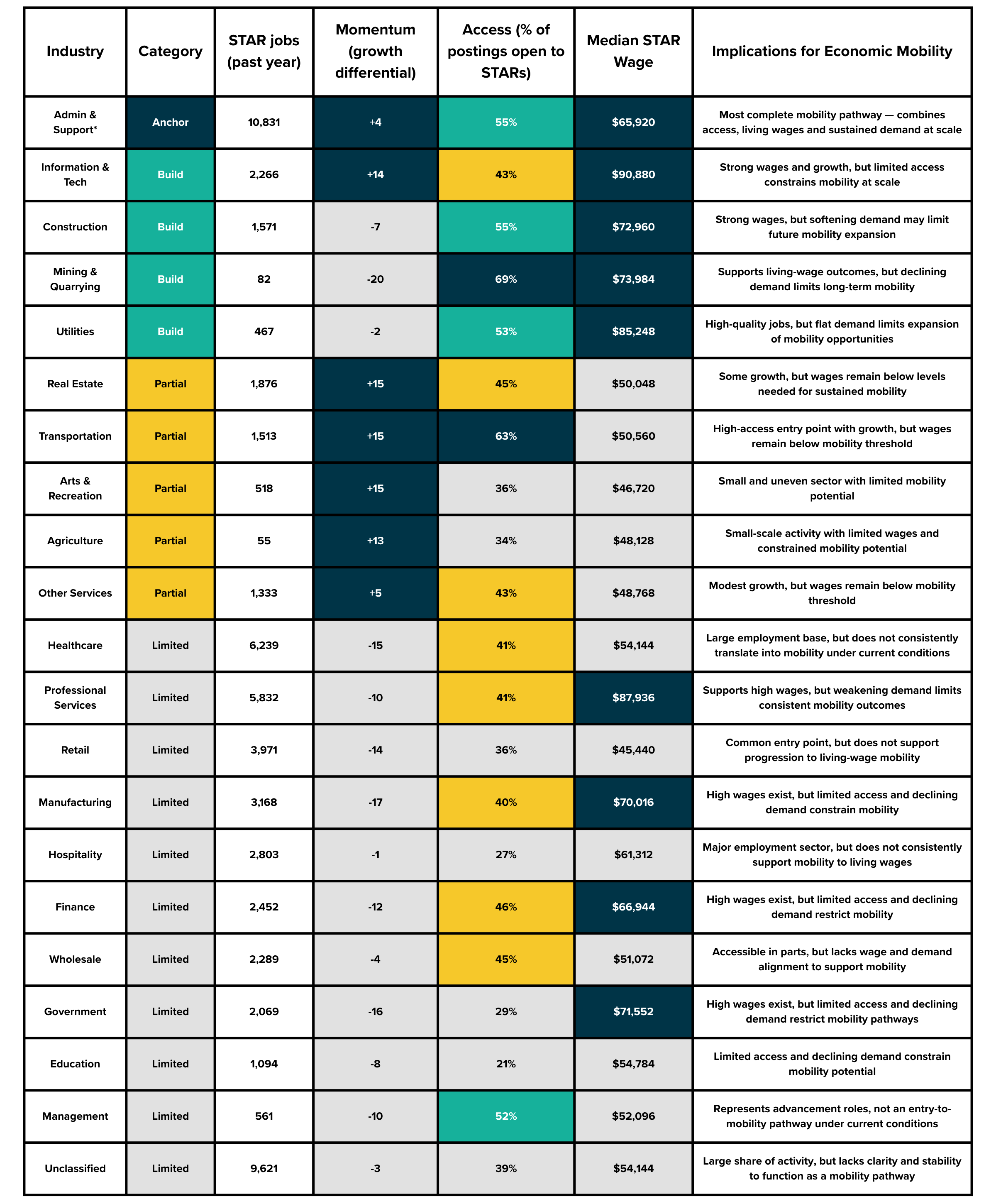
*Admin & Support is largely made of healthcare staffing agencies.
Strongest Signal:
Information and technology
In Honolulu, Information & Technology represents an emerging high-value pathway—where strong wages and expanding access are present, but the sector has not yet developed into a broadly accessible or fully formed career pathway at scale. When we filter to industries where STARs roles meet the living wage threshold, one sector stands out clearly in Honolulu:
43% of roles are STARs-accessible
Median STAR wage: ~$90,000 (well above the county living wage of ~$62,000)
STARs roles are growing (+6%) while overall postings are declining (-8%)
+14 percentage point growth differential
This is a sector where wages are strong and access is beginning to expand. Growth is occurring within STARs-accessible roles even as overall demand declines—indicating a shift toward positions that do not require a four-year degree. At the same time, wages are among the highest in the dataset, pointing to significant economic opportunity.
However, access remains below the majority threshold, and many of the roles driving growth are not core technical positions. Instead, demand is concentrated in customer-facing, administrative, and business support functions connected to the broader digital economy.
As a result, the sector reflects an important but incomplete mobility pathway—where high-value opportunity exists, but is not yet broadly accessible. This makes Information & Technology a high-value but incomplete pathway—where targeted efforts to expand access could unlock significantly more mobility.
Common roles (by posting volume)
Sales Representatives (Non-Technical) — 155
Software Developers — 140
Marketing Managers — 113
Customer Service Representatives — 113
Sales Managers — 92
Top hiring employers
Datavant — 487
Lumen Technologies — 315
Confluent — 150
Pearson Education — 132
Intuit — 103
What the Data Suggests
1. Wages are strong across a range of roles. This includes both technical and business-facing positions.
2. Access is improving—but not yet broad. Growth in STARs roles suggests increasing openness, but less than half of roles are currently accessible.
3. The sector is expanding through hybrid roles. Many opportunities sit at the intersection of technology, sales, operations, and support.
The quiet backbone sectors:
administrative & support services; utilities; public administration; finance
Several industries don’t immediately stand out on growth differential—but still represent meaningful opportunity due to scale and stability.
administrative & support services
In Honolulu, Administrative & Support Services plays a critical role in enabling workforce mobility—not by concentrating opportunity within a single industry, but by helping workers access and move between opportunities across the broader economy. This is not a destination sector—it is a connector across the economy.
55% STARs access (high)
STAR wage: ~$65,000 (above living wage)
~25% overall job growth
Modest growth differential (+4%)
This remains one of the most balanced large-scale pathways—offering accessibility, livable wages, and sustained demand. However, this sector functions differently from others highlighted in this analysis. Rather than representing a single industry with clearly defined career pathways, it reflects a collection of transferable roles—such as administrative support, customer service, and bookkeeping—that are needed across many sectors.
Many of the largest hiring employers in this category are staffing and intermediary firms. These organizations do not define the underlying demand—they connect workers to roles across industries where those skills are needed.
As a result, this sector is best understood not as a destination, but as a pathway layer—one that provides entry points into the workforce and enables workers to build skills and transition into other sectors over time.
Common roles (by posting volume)
Administrative Assistants — 535
Customer Service Representatives — 499
Bookkeeping & Accounting Clerks — 396
Maintenance & Repair Workers — 224
Top hiring employers
Robert Half — 842
Express Employment Professionals — 693
TEKsystems — 616
Altres — 557
Beacon Hill Staffing Group — 300
What the Data Suggests
1. Opportunity is distributed across many industries. These roles appear across sectors, reflecting broad underlying demand rather than a single industry pathway.
2. Staffing firms function as connectors within the labor market. Large intermediary employers indicate that many workers are entering roles through placement rather than direct hiring.
3. Skills are transferable across sectors. The types of roles in this category support movement between industries, rather than long-term specialization within one.
4. Mobility is enabled—but not contained. This sector helps workers enter and navigate the labor market, but does not by itself provide a complete pathway to long-term advancement.
Utilities
In Honolulu, Utilities represents a high-value opportunity for workforce development—not because it is broadly accessible today, but because targeted training pathways can create access to stable, well-paying roles in essential infrastructure and clean energy. This is also an area where workforce investments can align with broader infrastructure and clean energy priorities.
Strong wages (above living wage)
~34% overall growth
Slightly negative growth differential
Growth is happening—but not specifically concentrated in STARs roles
This is a high-wage, infrastructure-driven sector where demand is growing—but access is more limited and typically requires specific technical credentials.
Many of the roles driving demand—such as electricians, solar installers, and maintenance workers—are part of the skilled trades and energy workforce. These roles are accessible through targeted training and certification pathways, but are not as widely available to workers without those credentials.
As a result, while this sector offers strong earning potential, it does not currently function as a broad-access entry point. Instead, it represents a set of more structured pathways into stable, technical careers tied to energy systems and infrastructure.
Common roles (by posting volume)
Securities, Commodities & Financial Services Sales Agents — 32
Electricians — 16
Computer Occupations (Other) — 15
Solar Photovoltaic Installers — 14
General & Operations Managers — 14
Top hiring employers
Hawaiian Electric Industries — 170
Hawaiian Electric Company — 157
Revolusun — 19
AES Corporation — 18
Hi-Power Solar — 17
What the Data Suggests
1. Wages are consistently strong in infrastructure and energy roles. Many positions meet or exceed the living wage threshold, particularly in technical and skilled trades occupations.
2. Access depends on targeted training and credentials. Entry into these roles typically requires certifications or specialized training rather than general entry pathways.
3. Growth is not expanding access on its own. Demand is increasing, but not disproportionately in STARs-accessible roles.
4. The sector reflects structured, not open, pathways. Opportunity exists—but requires intentional alignment between training systems and employer demand.
Public administration (government)
In Honolulu, public sector jobs represent a critical source of high-quality employment—but expanding access depends less on creating new roles and more on improving visibility, navigation, and entry pathways into existing systems.
STAR wage: ~$71,000
~23% growth in STARs roles
Lower access (~29%)
Negative growth differential
These are high-quality, stable jobs—but access is governed by formal requirements and structured hiring processes. Public sector roles offer strong wages, benefits, and long-term stability. However, entry into these roles is often shaped by civil service systems, credential requirements, and hiring processes that can make pathways less visible or more difficult to navigate.
The types of roles being hired—ranging from administrative and HR positions to inspectors, trades, and public safety roles—reflect a wide range of opportunities. But unlike other sectors, access is not driven primarily by market demand alone. It is also shaped by institutional processes and eligibility criteria.
As a result, while these roles represent some of the most stable and well-compensated opportunities available, they are not always easily accessible without targeted support and navigation.
Common roles (by posting volume)
Administrative Assistants — 181
Bookkeeping & Accounting Clerks — 66
Police & Sheriff’s Patrol Officers — 62
Managers (Other) — 59
Plumbers, Pipefitters & Steamfitters — 48
Top hiring employers
State of Hawaiʻi — 448
City & County of Honolulu — 439
Hawaiʻi DOE — 259
U.S. Department of Defense — 251
U.S. Pacific Fleet — 106
What the Data Suggests
1. Growth is concentrated in higher-barrier roles. Expansion is occurring in positions that require credentials, limiting access for STARs workers.
2. Accessible roles are lower-wage and not expanding. Entry-level positions remain below the living wage threshold and are not driving growth
3. Policy alignment is a key lever. As a public sector, changes to hiring, credentialing, and career pathways could directly expand access to higher-quality jobs.
Finance
In Honolulu, Finance represents a tiered opportunity structure—where access into the sector is possible, but upward mobility into higher-wage roles depends on the availability of defined advancement pathways.
Strong wages
Positive overall growth (~13%)
Negative STARs growth differential (-12%)
This is a high-wage sector where overall growth is occurring, but that growth is concentrated in roles that are less accessible to workers without traditional credentials.
Entry-level roles—such as customer service, sales, and loan support positions—provide initial access into the sector. However, advancement into higher-paying roles often requires additional credentials, specialized training, or prior experience.
As a result, while the sector offers strong earning potential, it does not currently function as a broad pathway to mobility without clear and supported progression routes.
Common roles (by posting volume)
Customer Service Representatives — 227
Securities & Financial Services Sales Agents — 180
Claims Adjusters & Examiners — 136
Medical & Health Services Managers — 102
Sales Representatives (Services) — 93
Top hiring employers
UnitedHealth Group — 195
Bank of Hawaiʻi — 181
Central Pacific Bank — 160
Carrington — 126
Hawaiʻi State Federal Credit Union — 108
What the Data Suggests
1. Jobs are stable, well-compensated, and benefit-rich. Public sector roles consistently meet or exceed living wage thresholds and offer long-term employment stability.
2. Access is shaped by systems, not just demand. Hiring is governed by civil service rules, credential requirements, and formal application processes.
3. Growth does not automatically expand accessibility. Even as STARs roles grow, overall access remains limited relative to other sectors.
4. Navigation is a key barrier to entry. Expanding participation depends on improving awareness, guidance, and alignment with hiring pathways.
What doesn’t scale:
mining & quarrying
In Honolulu, Mining & Quarrying reflects localized, specialized opportunity—not a scalable pathway for workforce mobility at the system level.
High access (~69%)
Strong wages
Positive growth (but small volume: ~82 postings)
This sector shows strong indicators on access, wages, and growth—but at a very small scale. The total number of roles is limited, and activity is concentrated in a narrow set of specialized functions.
As a result, while individual opportunities may be high-quality, this sector does not represent a pathway that can absorb a large number of workers or meaningfully shift overall workforce outcomes in Honolulu.
Common roles (by posting volume)
Construction Managers — 11
Electrical & Electronics Installers and Repairers — 5
Clinical Laboratory Technologists and Technicians — 5
Dispatchers — 4
Electricians — 4
Top hiring employers
Arctic Slope Regional Corporation — 40
Knife River — 19
United Construction Group — 9
Global Dynamics — 5
Valley Well Drilling — 3
What the Data Suggests
1. Strong signals can exist at very small scale. High access, wages, and growth do not necessarily translate into system-wide impact.
2. Opportunities are specialized and concentrated. Roles are tied to specific technical functions and a small number of employers.
3. Scale limits workforce impact. The total number of postings is too small to absorb large numbers of workers.
4. Not all aligned sectors are strategic priorities. Even well-aligned sectors may not be relevant for broad workforce planning if scale is limited.

an entry point without sustainability:
transportation & warehousing
In Honolulu, Transportation & Warehousing functions as a high-access entry point into the workforce—but requires connections to higher-wage sectors or advancement pathways to support sustained economic mobility.
63% STARs access (high)
Median wage: ~$50,000 (below living wage)
STARs roles growing much faster (+17%) than overall jobs (+2%)
+15 growth differential
This is a clear entry-point sector—offering high accessibility and strong demand for workers. However, many of the roles driving that demand do not meet the living wage threshold, and pathways to higher-wage positions within the sector are more limited.
As a result, while this sector plays an important role in helping individuals enter the workforce and gain experience, it does not consistently provide a pathway to long-term economic stability on its own. In practice, this means many workers can find jobs quickly—but not jobs that allow them to stay and get ahead without transitioning elsewhere.
Common roles (by posting volume)
Heavy and Tractor-Trailer Truck Drivers — 130
Aircraft Mechanics and Service Technicians — 113
Airfield Operations Specialists — 108
Driver/Sales Workers — 86
Customer Service Representatives — 84
Top hiring employers
Alaska Airlines — 86
Hawaiian Holdings — 78
DoorDash — 65
United States Postal Service — 60
FedEx — 49
What the Data Suggests
1. Access is high and expanding. A large share of roles are open to workers without degrees, with growth concentrated in these positions.
2. Roles cluster in operational and service functions. Many jobs focus on logistics, transportation support, and customer-facing work.
3. Wages limit long-term stability. Most roles fall below the living wage threshold, constraining economic mobility within the sector.
4. Mobility depends on connections to other sectors. Advancing to higher-wage careers typically requires movement into other industries or structured progression pathways.
interpreting growth correctly
Not all growth signals represent real opportunity. Interpreting momentum requires understanding whether growth is absolute—or simply less negative than the broader trend. Some sectors show a positive growth differential—but are still declining overall. Examples include:
Real Estate
Arts & Recreation
Agriculture
These are not true growth sectors. Instead, they reflect industries where overall demand is shrinking, but STARs roles are declining more slowly than the rest of the market.
As a result, a positive differential in these cases does not indicate expanding opportunity—it reflects relative contraction.
Taken together, this analysis shows that economic mobility in Honolulu is not absent—it is fragmented across different parts of the economy.
But it also shows something more important: the building blocks for mobility already exist. The challenge now is to connect these pieces into pathways that allow workers to move from entry to higher-wage roles over time.
In Honolulu, workforce opportunity is fragmented across sectors—requiring movement between different parts of the labor market to achieve long-term economic mobility. Honolulu’s labor market offers a wide range of opportunities—but the elements required for a complete workforce pathway are distributed across different sectors rather than aligned within the same ones.
As a result, workers can often find entry points, and high-wage roles do exist—but the connection between the two is not always clear or structured. When you step back, a clear pattern emerges:
High-access sectors (Transportation, Admin) → lower wages
High-wage sectors (Information, Finance, Government) → lower access
Growth is occurring—but not consistently in accessible roles
A Workforce Strategy for Honolulu County
Honolulu is not lacking opportunity—it is lacking connection between different types of opportunity. Workers are often able to enter the labor market through high-access sectors such as Transportation & Warehousing or Administrative & Support Services. However, advancing to higher-wage roles typically requires transitioning into other sectors—such as Information & Technology, Government, or Finance—where access is more limited and pathways are less visible.
This means that upward mobility depends not just on job availability, but on the ability to navigate across sectors over time through connected mobility pathways.
In Honolulu, workforce strategy must focus on strengthening connections between sectors—so that entry points lead more reliably to higher-wage opportunities.
honolulu County:
implications and strategies
In Honolulu, upward mobility depends on the ability to move between sectors and on whether we design pathways that make that movement possible.
roots to canopy
Explore Episode 4
Mobility through Lifelong Learning
An introduction to what we know about workforce training from UHERO’s analysis of Good Jobs Hawaiʻi; how we define workforce opportunity; and statewide mobility trends.

Mobility in Hawaiʻi County
An in-depth analysis of industries; workforce opportunities and challenges; and the potential impact of investment in mobility pathways in Hawaiʻi County.

Mobility in Maui County
An in-depth analysis of industries; workforce opportunities and challenges; and the potential impact of investment in mobility pathways in Maui County.

Mobility in Kauaʻi County
An in-depth analysis of industries; workforce opportunities and challenges; and the potential impact of investment in mobility pathways in Kauaʻi County.

Learnings and Recommendations
What we learned through this episode; how upward mobility relates to Hawaiʻi’s Generational Workforce Commitment; and actions we can take now.