PERSPECTIVE: Evidence and Curiosity in an Uncertain Future
What Hawaiʻi’s workforce challenges are teaching us about acting, learning, and adapting when we cannot know exactly what comes next.
By Matt Stevens
Executive Director, Hawaiʻi Workforce Funders Collaborative
September 26, 2026
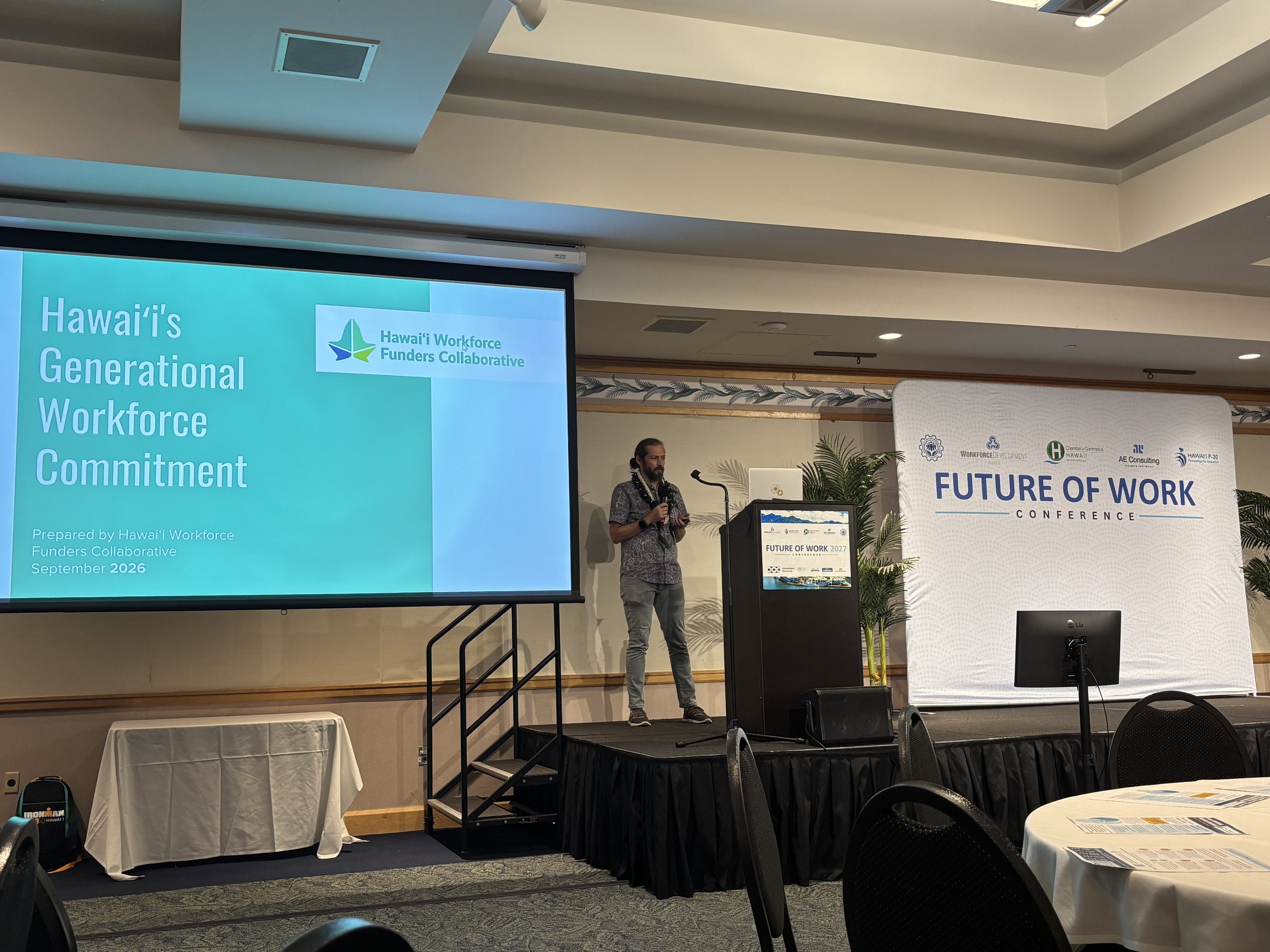
Photo Credit: Vincent Kimura
At the Future of Work 2027 Conference earlier this week, I was asked to talk about Hawaiʻi’s Generational Workforce Commitment and what it might take to turn that shared goal into action. It was an interesting assignment for a conference focused on the future of work. Throughout the day, conversations ranged from technology and AI to emerging jobs and skills, recruitment and retention, education and industry alignment, career pathways, culture, community, and resilience.
Underlying many of those conversations was the same basic question: What is coming next, and how do we prepare for it?
We understandably turn to evidence for answers. Which occupations are growing? What will AI automate? Which skills will employers need? What industries might emerge? Those are important questions, and we should continue asking them. But I have been thinking about another role for evidence, because sometimes we ask it to do something it simply cannot do: eliminate uncertainty.
We are not going to perfectly predict Hawaiʻi’s economy in 2045. We cannot know exactly how technology will change particular occupations, which industries will emerge, or how the aspirations of the next generation will evolve. But uncertainty does not make us powerless. It changes what we should expect from the information we have.
I have increasingly come to believe that good workforce decisions require both evidence and curiosity. Evidence gives us something solid to stand on. Curiosity keeps us open to what we have not yet understood.
Letting the evidence change the question
That idea has shaped much of our work over the past year through The Workforce Understory. We started with questions that seemed relatively straightforward: Will Hawaiʻi have enough jobs for the next generation? Are our education and workforce systems preparing people for those jobs? Does opportunity look the same across the state?
As we looked more closely at the evidence, however, we found ourselves changing the questions.
Roughly 170,000 young people are expected to enter Hawaiʻi’s workforce over the next decade. Based on current projections, there are only about 101,000 living-wage job openings available to them. Even if our education and training systems worked perfectly—even if every learner received exactly the right preparation for exactly the right occupation—we would still face a more fundamental problem: our economy is not currently projected to create enough living-wage opportunities for everyone entering the workforce.
Those opportunities are also distributed very differently across the state. Our analysis suggests that about 62 percent of workforce entrants on Oʻahu can expect access to a living-wage opening under current projections. On Maui, that falls to about 45 percent; on Hawaiʻi Island, 34 percent; and on Kauaʻi, 29 percent. Hawaiʻi may share a workforce challenge, but it does not have a single labor market.
The evidence therefore pushed us beyond asking whether Hawaiʻi has enough jobs. A more useful question became: Where is there real opportunity? Where do wages, employer demand, accessibility, and opportunities for advancement actually come together?
We encountered a similar shift when we looked at education. Hawaiʻi has a highly educated workforce, yet only about 43 percent of our four-year college graduates are working in a college-level job within five years of graduation. When we compare earnings with Hawaiʻi’s cost of living, our college graduates also fare substantially worse than graduates in many other states.
None of that suggests education is unimportant. It suggests that education alone is not the outcome. A credential creates value when it connects someone to opportunity. Training matters when there is somewhere meaningful to go next. Preparing more people is not enough if the opportunities available to them remain inaccessible, poorly connected, or unable to support a life in Hawaiʻi.
So that question changed too. Instead of asking only, How do we prepare more people?, we began asking, How do we connect people to quality careers?
Evidence as a starting point, not an endpoint
There is a larger lesson in those shifts. The purpose of evidence is not simply to confirm the strategy we already have. Sometimes its most valuable contribution is showing us that we have been asking the wrong question.
That happened repeatedly during the first season of The Workforce Understory. Counting jobs became measuring opportunity. Preparing workers became connecting people. Statewide averages gave way to more place-based questions about the very different labor markets across Hawaiʻi. And looking at individual programs pushed us toward a more systemic question: Are we actually building pathways that people can enter, navigate, and continue moving through over time?
This is where curiosity matters just as much as evidence.
Sometimes the evidence provides an answer. Sometimes it challenges an assumption. And sometimes it exposes a question we cannot yet answer well. That last outcome should not be viewed as a failure of analysis. Incomplete data cannot become a reason to stop asking questions. Instead, the questions we cannot answer should help us become more intentional about what Hawaiʻi needs to be able to see, measure, and understand next.
That is increasingly how I think about workforce intelligence. It is not simply a matter of producing more data or another dashboard. It is the collective capacity to notice what is changing, bring different forms of information together, understand what those signals mean, and adjust what we are doing as a result.
That distinction matters because workforce development is not a technical problem that can be solved by one perfect analysis. It is a collective challenge unfolding under conditions that will continue to change.
Building the capacity to adapt
Schools, employers, workforce organizations, community groups, government, philanthropy, workers, and learners all experience different parts of the workforce system. No single organization controls the whole pathway. That means our challenge is not to identify the institution with the answer; it is to build greater capacity to learn and act together.
Across the first season of The Workforce Understory, four principles kept surfacing: design around people rather than programs; connect pathways before simply expanding them; coordinate around shared outcomes; and build systems that continue learning.
The last of those has become particularly important to me.
The strongest workforce pathways are never finished. Industries evolve. Technology changes. Employers adopt different business models. Workers develop new aspirations. Communities experience economic and demographic change. A workforce strategy built around accurately predicting all of those changes will eventually be wrong. The alternative is not to abandon planning or evidence. It is to build systems that can learn from experience and adapt as conditions change.
That requires rigor. We should be clear about what the evidence actually tells us. We should measure whether investments are building the capabilities we intended, whether the system is beginning to work differently, and ultimately whether workers and learners are experiencing better outcomes.
But it also requires humility. We have to be willing to discover that the question we started with was not quite the right one. We have to be willing to revise a strategy when the evidence points somewhere new. And we have to resist the temptation to delay action until uncertainty disappears.
There is something freeing in that way of working. We do not have to know exactly what 2045 will look like in order to take the next good step. We need enough evidence to understand where we are, enough shared direction to know what we are trying to accomplish, and enough curiosity to keep learning as we move.
2045 is a discipline
Hawaiʻi’s Generational Workforce Commitment gives us that shared direction: by 2045, all people of Hawaiʻi should have a path to a career that allows them to learn, work, and thrive here. The goal can remain stable even as the way we reach it continues to evolve.
That is why I have started thinking about 2045 less as a deadline and more as a discipline.
It is the discipline of continuing to ask whether more people can access quality pathways, whether more people are reaching living-wage work and advancing over time, and whether opportunity is becoming more accessible across all of our communities. And when the answer is no, it is the discipline of asking whether we are learning quickly enough to change what we are doing.
We cannot remove uncertainty from the future of work. Nor should we confuse certainty with readiness.
Perhaps readiness looks different. It means being grounded enough in evidence to act, while remaining curious enough to recognize when reality is asking us to change.
For Hawaiʻi, that may be one of the most important workforce capacities we can build.
Matt Stevens is Executive Director of the Hawaiʻi Workforce Funders Collaborative. This essay reflects on ideas explored in his keynote at the Future of Work 2027 Conference on September 23, 2026.
WATCH THE FULL KEYNOTE
Video recording courtesy of Haylin Dennison