

Episode 3:
Paid Pathways as infrAstrUcture

If we are serious about building visible, supported bridges into living-wage work — what would that require?
Across Hawaiʻi’s workforce landscape, one pressure point connects multiple challenges at once: the transition from education into meaningful work.
For young people, that transition is often uncertain. Without visible and supported entry points, it is difficult to explore industries, build confidence, or believe that long-term opportunity exists within the state.
For employers, the challenge is not only recruitment, but connection. Many report difficulty filling roles or cultivating local talent prepared for emerging sectors. At the same time, young people frequently lack exposure to those very industries.
Paid, high-quality work-based learning experiences sit at the intersection of these dynamics. They provide structured, real-world exposure at the earliest point of workforce entry. They allow young people to explore industries before committing to long-term training pathways. They create supervised spaces to build skills, professional identity, and confidence.
Just as importantly, they shape perception. Early workplace experiences influence whether young people believe that stable, meaningful work is attainable in Hawaiʻi. That belief matters. It affects decisions about education, migration, and long-term investment in community.
As Hawaiʻi works to strengthen job quality and grow emerging sectors over time, paid pathways serve as the first visible bridge into that evolving economy. They connect youth to opportunity as it develops, and they signal to employers that local talent is present and engaged.
For these reasons, paid pathways into a first job function not simply as programs, but as early infrastructure. They are where belief, exposure, skill development, and employer engagement converge — making them a critical coordination point within the broader generational commitment.

the forest through the trees
why Creating infrastructure to meet Hawaiʻi’s generational workforce commitment matters now
With the launch of the Learn Work Thrive Hui and Hawaiʻi’s Generational Workforce Commitment (HGWC), we’ve moved from identifying the challenge to aligning around action—codifying of the commitment and identifying what implementation requires.
HGWC asks us to make steady, cumulative progress so that by 2045 every Hawaiʻi resident has a pathway to learn, work, and thrive. But workforce systems were not designed for generational execution; they operate through annual budgets, pilot programs, grant cycles, and short-term initiatives. Activity can occur every year without necessarily building toward a shared long-term outcome.
The challenge, then, is not simply whether strong programs exist. It is whether impact compounds over time—whether we can measure, with clarity and discipline, if we are meaningfully advancing toward our 2045 commitment.
Continue, coordinate, catalyze
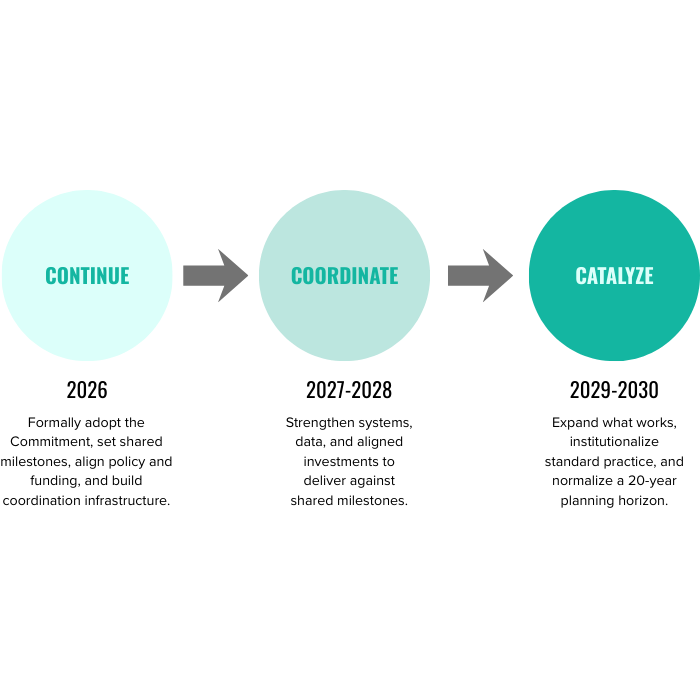
Over the past five years, investments in work-based learning, sector partnerships, career navigation, data infrastructure, and employer engagement have strengthened the workforce ecosystem across islands. As outlined in From Crisis to Coalition, this work has created new alignment and a growing coalition of agencies, employers, educators, and funders committed to a shared generational goal.
For 2026, much of this work must continue. Programs that are producing value should not be disrupted. Partnerships that have taken years to build must be sustained. Early investments in data and coordination need stability. But a 20-year commitment requires more than continuation. It requires coordination — shared definitions of success, shared recruitment strategies, shared metrics, and clearer visibility into what is working statewide.
Without coordination, strong programs remain isolated. With coordination, their impact can compound and lead to catalyzing durable infrastructure: sustained funding streams, codified commitments, and systems designed not just to pilot innovation, but to scale it.

from pilots to systems
This episode sits at the boundary between Continue and Coordinate. It focuses on one of the commitment’s most visible and actionable levers — paid, high-quality pathways into a first job — and examines what it would take for this work to move from strong individual programs to coordinated statewide infrastructure.
If Hawaiʻi is serious about its 2045 horizon, what would it mean to design these pathways not as pilots, but as a system capable of reaching every young person entering the workforce over the next decade?
So, what would it take to scale internships in Hawaiʻi from pilots to a systems-level solution for building Hawaiʻi’s workforce?

Mahalo to all the individuals and organizations who contributed to this episode: Janna Hoshide of Healthcare Association of Hawaiʻi, Katie Taladay of Maui Economic Development Board, and Tracie Foglia of Hawaiʻi Employers Council.