

Episode 3:
Healthcare association of Hawaiʻi
Case sTUDY


Healthcare Association of Hawaiʻi (HAH) shows us
wage funding alone does not create placement capacity.
The Workforce Understory spoke with Janna Hoshide of Healthcare Association of Hawaiʻi and learned how and why sustained intermediary infrastructure is required for placements to grow while maintaining quality and employer participation.
In modeling what it would take to scale internships, we included a 20% investment in the intermediary layer to account for the coordination, recruitment, employer engagement, and data systems required to scale placements statewide. The Healthcare Association of Hawaiʻi (HAH) provides a grounded example of how that work unfolds in practice.
Its high school certification program illustrates the operational labor behind each placement. Recruitment requires active outreach. Matching depends on relationships and alignment. Supervision quality requires employer coaching. Outcomes must be intentionally tracked.
While this episode examines paid internships as one model of early workforce exposure, HAH’s high school healthcare pathway has evolved into a direct employment model. Students are hired into entry-level or junior roles (such as clinical aide), with structured onboarding and transition-to-practice functions embedded into employment. Rather than operating as a standalone internship, the work-based learning component is absorbed into the early employment period. This shift emerged from program experience, prioritizing students who intend to enter the workforce directly and strengthening long-term retention.
Placement Mechanics: Matching is Labor
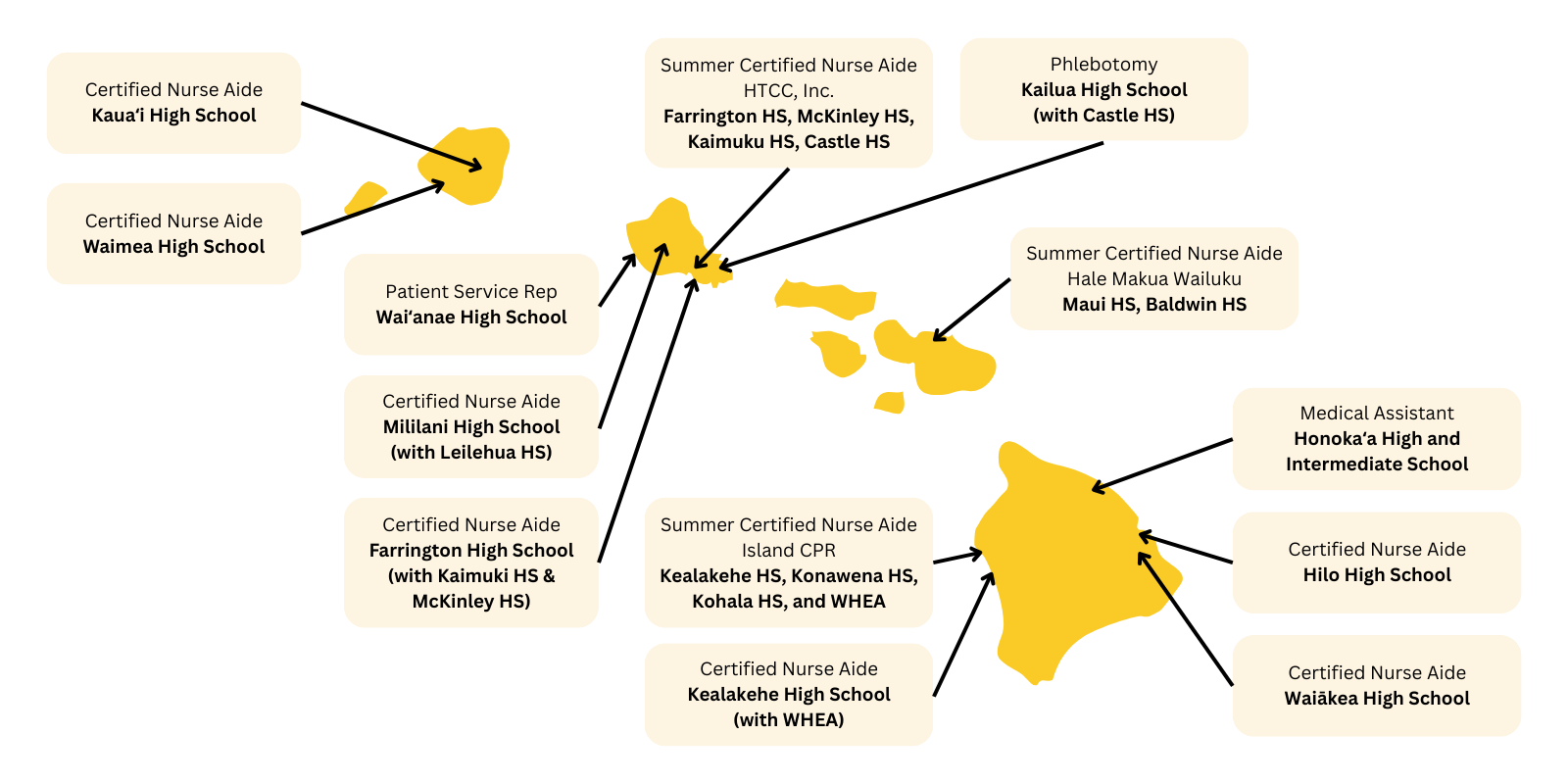
Over three years, HAH’s high school healthcare certification program expanded from 10 to 18 schools statewide. Annual student employment placements increased from 35 in 2022-23 to 78 the following year and 106 in 2024-25. Employment rates rose from 60% to 78% overall, with CNA placement rates increasing to 81%.
The numbers reflect program growth, which requires additional labor to run the program well.
Each cohort typically engages approximately three employer partners, all of whom must align hiring timelines with school calendars and certification schedules.
Employers are not passive recipients of candidates. HAH coordinates:
Advanced employer recruitment
Preparation for working with high school seniors
Adjustments to minimum qualifications where appropriate
Creation of part-time or flexible roles
Expedited hiring timelines
Holding positions open to align with graduation schedules
Students are screened for employment intention before entering the employment track. Throughout training, HAH provides:
Regular check-ins
Professionalism coaching
Job application support
Interview preparation
Employers present opportunities directly to students and collaborate with HAH to move candidates through the hiring process.
The result is not simply job placement. It is intentional, coordinated placement.
As placements increased from 35 to 106 annually, these coordination functions expanded alongside them. More schools required more employer outreach. Higher placement counts required more student coaching. Expanded clinical components and wraparound supports required additional staff time and ongoing troubleshooting across regions.
This is the operational reality - the hidden work behind each line in a placement count.

Employer Readiness Work: The Hidden Work
Reaching universal paid pathway access — whether through internships, employment-embedded models, or hybrid designs — would require recruiting only a small percentage (2–3%) of Hawaiʻi’s businesses to newly participate each year. HAH demonstrates what it takes to prepare those businesses to participate well.
Employer engagement begins long before a student is hired. HAH coaches employers on role design, supervision expectations, and hiring flexibility. Some employers adjust minimum qualifications, create part-time roles, expedite review timelines, or hold positions open to align with school graduation schedules. HAH also guides employers on setting clear expectations and providing structured feedback for first-time employees. HAH maintains ongoing communication throughout the placement to address friction early, clarify responsibilities, and troubleshoot challenges as they arise.
Over time, HAH transitioned from a standalone internship model to an employment-embedded pathway. Rather than placing students into temporary internship roles, employers hire students directly into entry-level positions and integrate structured work-based learning into onboarding and transition-to-practice. This design shift reflects a key insight: when learning is embedded within employment, employer commitment and student retention can strengthen.
This work functions as quality control. Quality employer participation is not automatic, it is cultivated.
Wage funding creates openings, but employer readiness determines whether those openings translate into successful placements.
Without intermediary coordination….
Supervision gaps widen
Expectations misalign
Student confidence erodes
Employer frustration increases
participation declines. Growth stalls
With coaching and feedback cycles in place…
Employers refine processes
Students transition more smoothly
Trust increases
Repeat participation increases
Organizational and systemic gains compound.

Data discipline: What gets Measured (and what doesn’t)
If paid pathways are infrastructure, then measurement is not optional
because it determines whether impact compounds or merely repeats.
HAH tracks core performance indicators with intention. These include:
Total students trained
Employment track participation
Completion rates
Annual placement counts
Employment rates by credential type
Participant demographics, including Native Hawaiian and Pacific Islander representation
Initial employment outcomes
These metrics allow HAH to refine program design year over year. Employment rates increased from 60% to 78% over three years. CNA placement rates rose to 81%. Cohort size, school participation, and employment track alignment are evaluated annually and adjusted accordingly.
This is disciplined program management. At the same time, important longitudinal questions remain difficult to answer. HAH does not yet have comprehensive visibility into:
Long-term wage progression
Retention in the healthcare sector
Multi-year career mobility
Whether early placements translate into durable career pathways
Retention tracking has begun in collaboration with employers, but long-term data collection presents logistical and capacity challenges.
Strong programs collect useful data. Coordinated systems align data across programs. HAH demonstrates the first. The second remains a statewide opportunity.
The shift from “continue” to “coordinate”
Without shared definitions, shared reporting structures, and linked longitudinal tracking, it is difficult to determine whether individual program successes are compounding toward the 2045 commitment. It is not about replacing strong programs, but rather connecting their data so collective progress becomes visible.
Capacity constraints: What limits growth
HAH’s expansion reflects rising demand and improved design. But demand alone does not determine scale. Growth is constrained by capacity.
Staffing bandwidth shapes how many employers can be recruited, coached, and supported in a given year. Expanded wraparound services improved outcomes, but they also increased staff time and coordination requirements.
Funding stability matters. The program operates within legislative and DBEDT funding cycles. Short-term appropriations limit long-term hiring and expansion planning.
Employer participation requires ongoing cultivation. Without continued support and troubleshooting, hiring processes revert and participation fluctuates.
Student readiness varies by cohort and region. Screening, coaching, and professionalism training mitigate that variability, but require sustained staff attention. Geographic dispersion across islands adds additional coordination complexity.
HAH’s growth is not limited by student interest alone. It is limited by the lack of:

Predictable funding

Staff bandwidth

Employer onboarding capacity
Data infrastructure
Adding an additional 1,493 placements per year to reach universal access in a decade
The increase isn’t just about adding students. It means adding recruiters, employer coaches, data managers, and program coordinators. Deliberate investments in the 20% intermediary layer present in these roles.
Without them, placements can increase temporarily but quality erodes and participation declines. With them, growth can compound.

The takeaway: Scaling paid pathways isn’t only about wages, it’s about infrastructure.
Recruitment, matching, employer coaching, supervision alignment, and data tracking are skilled, ongoing functions that do not occur automatically when wage funding is available. They require staffing, coordination, and continuity.
As placements increase from dozens to hundreds, intermediary capacity must expand alongside them. Without that operational muscle quality erodes, employer satisfaction declines, participation fluctuates, and growth stalls. With it, placements can increase while maintaining consistency, employer trust, and student readiness.
Intermediaries are not administrative overhead. They are the scaling mechanism.
This insight reinforces our systems modeling. The 20% intermediary layer reflects real roles and real labor. Without disciplined coordination and measurement, individual program gains remain isolated. With coordination, they can accumulate. If HAH makes the intermediary layer visible at the program level, the next question is regional: what does it take to cultivate the employer ecosystems that make distributed participation possible across islands?

The operational realities
Internships are not self-executing
Employer participation must be cultivated
Quality requires supervision coaching
Data requires intention
Growth requires staffing
Intermediary capacity is not overhead, it is infrastructure
roots to canopy
Explore Episode 3
Episode 3: Paid Pathways as Infrastructure
Learn about the paid internship and first job landscape through case studies and employer perspectives.
MEDB STEMworks Case Study
Maui Economic Development Board STEMworks Program demonstrates scaling requires ecosystem design: early exposure, sector alignment, education partnerships, employer, trust, and place-based coordination.

Employer Perspectives: Costs and Benefits
Hawaiʻi Employers Council shares the misconceptions employers have around what internships, as well as the key building blocks for a quality internship and what employers stand to gain by investing in young people.

What we learned and where the data points.
Signals, answers, and questions that can inform policy, research, and strategy moving forward.